
Fractional CFO vs Bookkeeper vs Tax Accountant: What SMEs Need to Know

For many Australian SME business owners, finance is often viewed as one function. Someone looks after the books, someone prepares the tax return, and someone provides advice when needed.
But a bookkeeper, a tax accountant and a Chief Financial Officer do very different work.
All three roles are important. All three can add value. But they are not interchangeable.
Understanding the difference is critical when choosing financial support for your business, particularly if you are looking for a Fractional CFO in Australia, a Fractional CFO in Melbourne, a Fractional CFO in Sydney or a Fractional CFO in Brisbane.
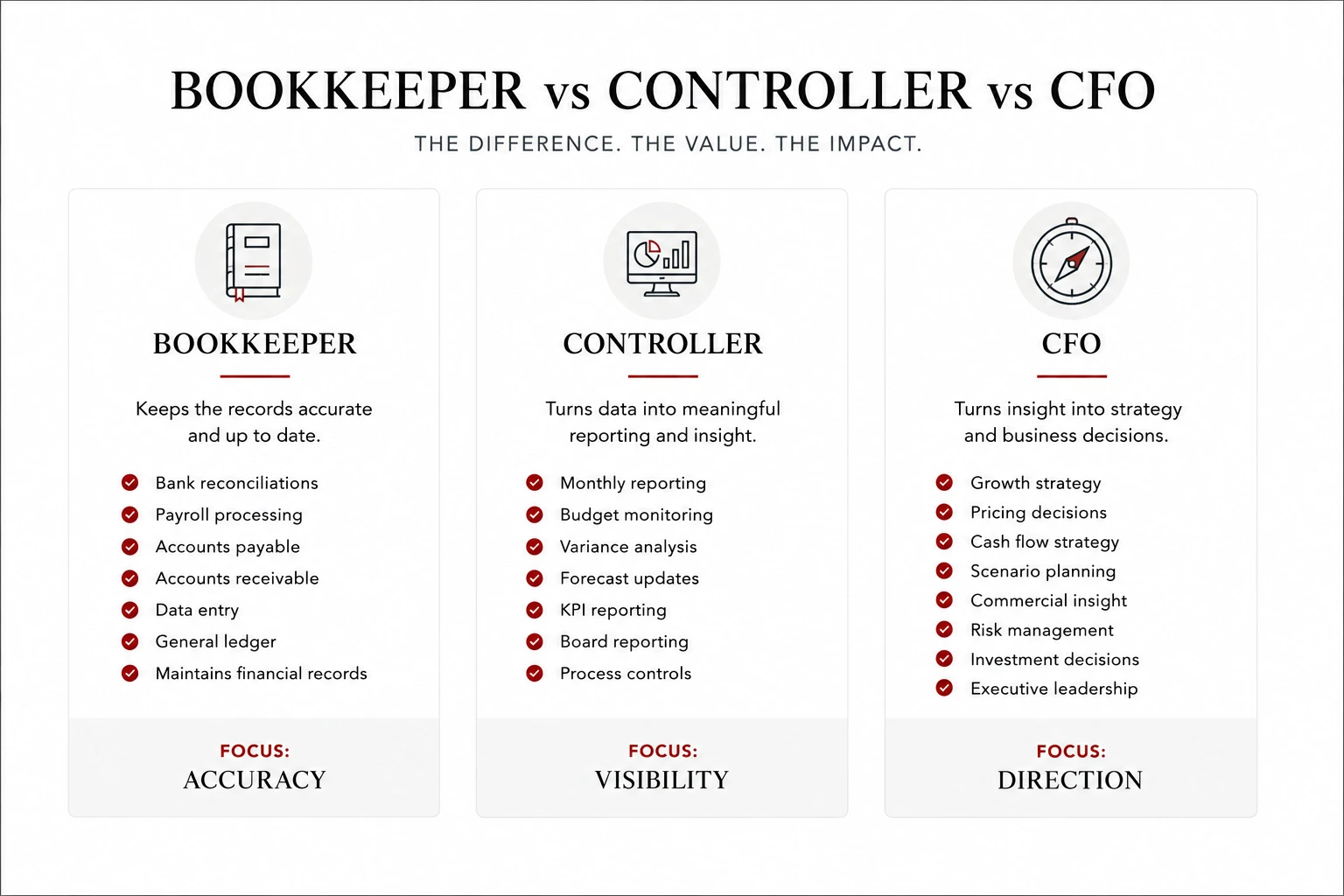
The bookkeeper: accurate financial data
The bookkeeper is responsible for keeping the financial records accurate and up to date.
This includes processing transactions, reconciling bank accounts, coding income and expenses, maintaining payroll records and ensuring the business has clean financial data.
This work is essential. Without accurate bookkeeping, the tax accountant, the CFO and the business owner are all working from unreliable information.
A strong bookkeeper gives the business a clean financial foundation.
The tax accountant: compliance and tax advice
The tax accountant uses the financial records to manage compliance obligations.
This may include BAS lodgements, tax returns, Fringe Benefits Tax, tax planning, payroll tax considerations and advice on tax legislation.
This is a specialist role. Tax accountants help ensure the business meets its obligations and manages tax risk appropriately.
However, tax compliance is not the same as commercial financial leadership.
A tax accountant may be excellent at tax. That does not automatically mean they are trained to act as a strategic CFO.
The CFO: commercial leadership and decision-making
A CFO uses financial information differently.
The CFO is not only asking what happened. A commercially minded CFO is asking why it happened, what it means, what risks are emerging and what decisions need to be made next.
A CFO looks for patterns in the numbers. They connect financial performance with operations, pricing, cash flow, growth, resourcing and strategy.
In larger organisations, CFOs sit close to the executive team because financial leadership is central to decision-making. SMEs need access to that same commercial capability, but usually without the cost of a full-time executive. That is where a Fractional CFO service can be valuable.
Three important roles. Three different skill sets.
Bookkeeper
Maintains accurate records, reconciles transactions and keeps the financial data organised.
Tax Accountant
Manages tax compliance, BAS, tax returns, FBT and tax-related obligations.
CFO
Uses financial information to guide strategy, improve decision-making and support business growth.
The strongest businesses understand the difference.
The bookkeeper provides the data. The tax accountant manages compliance. The CFO uses the information to help the business make better decisions.
If someone has spent their career in bookkeeping or suburban tax accounting, they may be highly capable in that field. But that does not automatically mean they have the commercial experience, strategic judgement or leadership capability required to operate as a CFO.
Why SMEs need to check who is acting as their CFO
The term CFO is now used widely across the market. But not every person using the title has the same experience.
Before appointing a Fractional CFO, business owners should look carefully at the person’s background, commercial experience and ability to operate beyond reporting and compliance.
Useful questions include:
- Have they worked in commercial finance or FP&A roles?
- Have they supported executive teams or senior decision-makers?
- Can they interpret numbers commercially, not just prepare them?
- Do they understand pricing, margins, cash flow, forecasting and performance drivers?
- Can they challenge assumptions and guide business owners through decisions?
- Do they have experience helping businesses grow, restructure or improve performance?
There are different levels of financial support. The level you choose will influence the direction of your business.
When a business needs more than bookkeeping
Many SMEs start with bookkeeping and tax compliance. That is appropriate in the early stages.
But as the business grows, the questions become more complex.
Can we afford to hire? Are our margins strong enough? Which customers are profitable? Why is revenue increasing but cash flow still tight? Should we expand into another location? Are we pricing correctly? What does the next 12 months look like?
These are not bookkeeping questions. They are CFO questions.
For SMEs that need better reporting, clearer financial insight and stronger decision support, The CFO Agency also provides Business Insights and Reporting services.
For businesses that need a complete finance function, including CFO oversight, bookkeeping, payroll and tax coordination, see our CFO and Finance Function service.
Fractional CFO Australia: choosing the right level of support
A Fractional CFO Australia service gives SMEs access to senior commercial finance capability without employing a full-time CFO.
This can be particularly valuable for growing businesses that need strategic input, better management reporting, improved cash flow visibility and stronger decision-making.
Whether you are looking for a Fractional CFO Melbourne, Fractional CFO Sydney or Fractional CFO Brisbane service, the principle is the same: choose the person who has the right experience for the decisions your business needs to make.
A commercially minded CFO should help you understand where the business is heading, what needs to change and what decisions will create better outcomes.
Pick your CFO wisely
Bookkeepers, tax accountants and CFOs all play important roles in a business.
But they are different roles, requiring different training, different experience and different commercial judgement.
The bookkeeper keeps the records accurate. The tax accountant manages compliance. The CFO helps guide the business forward.
When you choose a CFO, you are choosing more than a finance provider. You are choosing the level of financial leadership that will sit beside you as you make decisions about the future of your business.
Choose carefully.
You can also view our case studies to see how commercial finance support can help SMEs improve clarity, structure and decision-making.
Need commercial finance leadership for your SME?
The CFO Agency provides Fractional CFO, Virtual CFO, business insights, reporting and finance function support for Australian SMEs.
If your business needs more than bookkeeping and compliance, we can help you understand the numbers and make better decisions from them.
Contact us for a quote